
Rowing asks something different of a shoe
Most athletic footwear is designed around walking, running or multidirectional movement. Rowing isn't any of those things.
Your feet remain connected to the foot stretcher while your body travels through a repeated movement cycle. During that cycle, the ankle moves through a substantial range of motion. Research examining rowers' ankle mobility has specifically measured both dorsiflexion and plantarflexion as part of the rowing stroke.
At the catch, the ankle closes as the shins move towards vertical. Through the drive, the legs extend and the ankle progressively opens. By the finish, the legs are straight and the ankle and lower leg have moved into a very different relationship from the catch.
And then you do it again.
Hundreds of times in a training session.
So why put a shoe in the way?
A conventional shoe often uses a relatively high heel counter to wrap and stabilize the rear of the foot.
That makes sense when the shoe needs to control the foot during running, walking or lateral movement.
But a rowing shoe is attached to a foot stretcher.
Rather than simply carrying conventional footwear construction into rowing, we looked at what structure was actually required around the heel.
The Bont Rowing Achilles cut-out removes material directly behind the Achilles while retaining structure on either side of the heel.
The objective is simple: support the heel without unnecessarily restricting the movement of the posterior ankle.
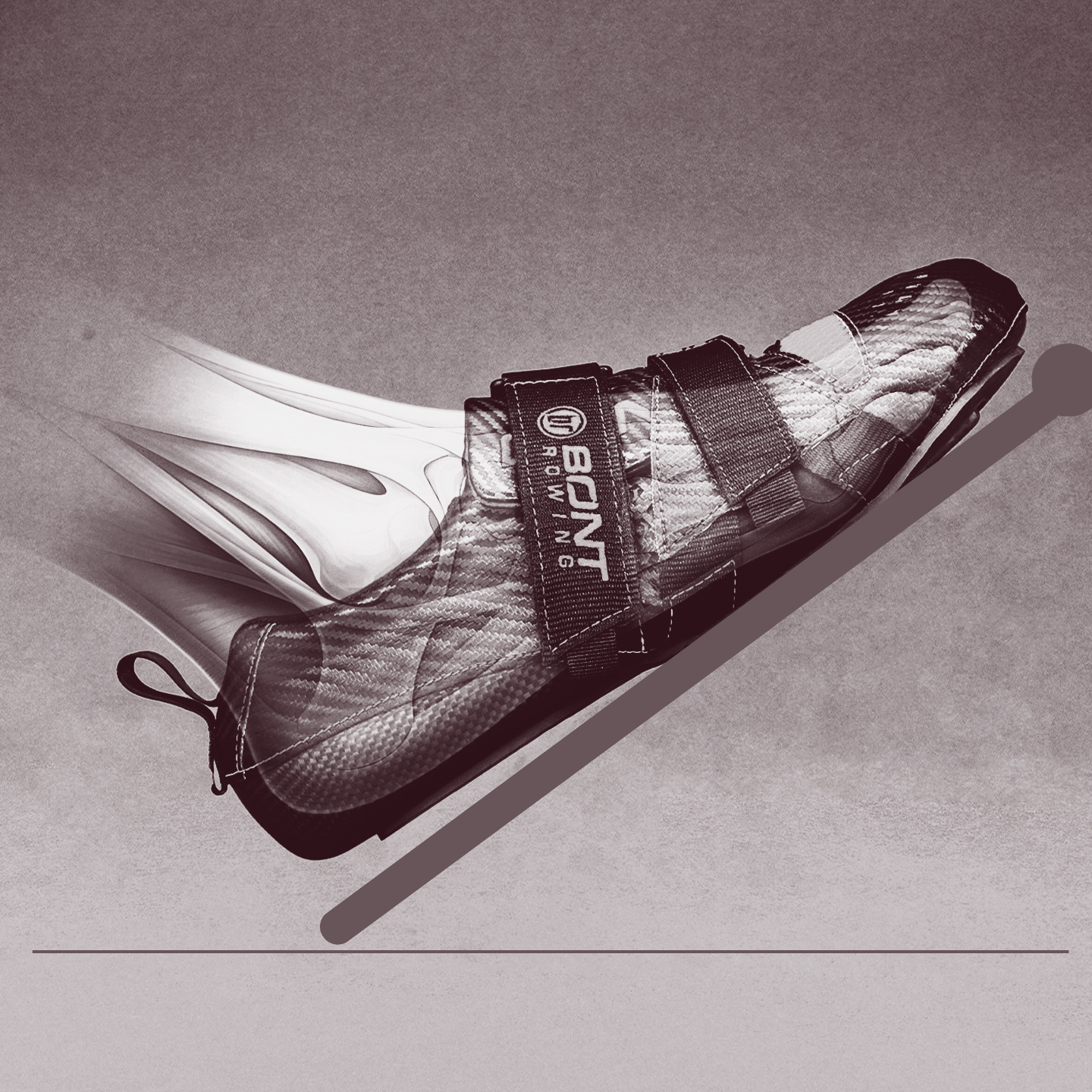
There is good biomechanical reason to consider this area carefully. Research outside rowing has demonstrated that restricting ankle movement can change Achilles tendon displacement and lower-leg muscle behavior.
We aren't claiming that an Achilles cut-out changes rowing performance or prevents injury without specific testing to demonstrate that. What we can say is that the design gives the Achilles region clearance rather than placing a conventional heel structure directly behind it.
Designed from the stroke backwards
Rowing footwear has historically borrowed heavily from footwear developed for other sports.
We think the better question is:
What does the foot actually need during a rowing stroke?
The Achilles cut-out is one answer.
The foot still needs to be securely located. The shoe still needs structure. But structure should be placed where it contributes to the function of the shoe — not simply because that's where shoes have traditionally had it.
Look closely at the back of a Bont Rowing shoe and you'll see the heel structure rising on either side, with the Achilles area left open between them.
That's deliberate.
Support where you need it. Freedom where you don't.
And another small example of why a rowing shoe should be designed specifically for rowing.